
ACC vs PCC Coaching: What’s the Difference and Which ICF Certification Is Right for You?
“Should I aim for ACC or go straight for PCC?”
It’s the question that can send you down a rabbit hole of acronyms, hour requirements, and conflicting advice. You’re not alone – it’s the most common question we hear from prospective students at ICA. And the answer shapes everything from the program you choose, to the clients you can work with, to how long it takes before you’re credentialed.
The thing is: ACC vs PCC coaching is not just a choice between two levels of the same certificate. They represent different stages of coaching capability, different entry points for your career, and different expectations from the market. At some point in your research, this becomes the pivotal question – and the answer needs to come before you enrol, not after. This guide is designed to give you that clarity.
The ICF: The Global Gold Standard for Coaching Credentials
The International Coaching Federation (ICF) is the global peak body for the coaching profession. Established in 1995, it has grown to represent over 100,000 members and nearly 56,000 credential-holders across 157 countries, working across industries including leadership, executive, health, career, business, and life coaching.
In the early days of professional coaching however, the landscape was fragmented. There were multiple associations, multiple training providers, and no single agreed benchmark for what “qualified” actually meant. Coaches often chose to align with the ICF as a forward-looking decision – essentially taking a view that this body, with its competency framework and ethical standards, would become the profession’s reference point.
Over time, that has proven to be correct.
As coaching matured and entered corporate environments, organizations began looking for consistency and quality assurance. HR departments, procurement teams, and leadership development functions needed a way to assess credibility, and increasingly, the ICF credential became that external benchmark.
Today, it is common for organizations to require internal and external coaches to hold an ICF credential — particularly at PCC level for executive and leadership coaching. In many global organisations, it is even written directly into vendor agreements and internal coaching frameworks.
The ICF offers three main credential levels:
- ACC (Associate Certified Coach): Entry-level professional credential
- PCC (Professional Certified Coach): Advanced professional credential
- MCC (Master Certified Coach): Expert-level credential (brief context: requires 2,500+ coaching hours)
For new and emerging coaches, the credential decision typically sits between an Associate Certified Coach (ACC) and a Professional Certified Coach (PCC) – with MCC being a later-stage credential pursued after significant professional experience.

Choosing between ACC vs PCC Coaching
This decision needs to be made before you enrol in a coach training program – not after. Achieving an ICF credential requires focus, rigour and commitment. You need to complete ICF accredited coach training, receive mentor coaching, record a coaching session for your performance evaluation, log a specific number of coaching hours, and then formally apply to the ICF for your credential (we outline this process further down in the article).
In other words, this is not something you decide casually at the end of your studies. It is a structured professional pathway. Given the time and financial investment involved, it deserves careful consideration upfront.
It is also a strategic decision. Your choice between ACC and PCC influences the level of training you undertake, the standard you are assessed against, and how you position yourself in the market. Some organisations require a minimum of PCC for executive or corporate coaching work. Some coaches begin with ACC as a stepping stone. Others train directly at PCC level to avoid repeating assessments later.
Understanding the differences clearly from the outset can save you time, money, and unnecessary re-credentialing — and ensure that your training aligns with your longer-term goals.
What the ICF Requires
| Requirement | ACC (Associate Certified Coach) | PCC (Professional Certified Coach) |
|---|---|---|
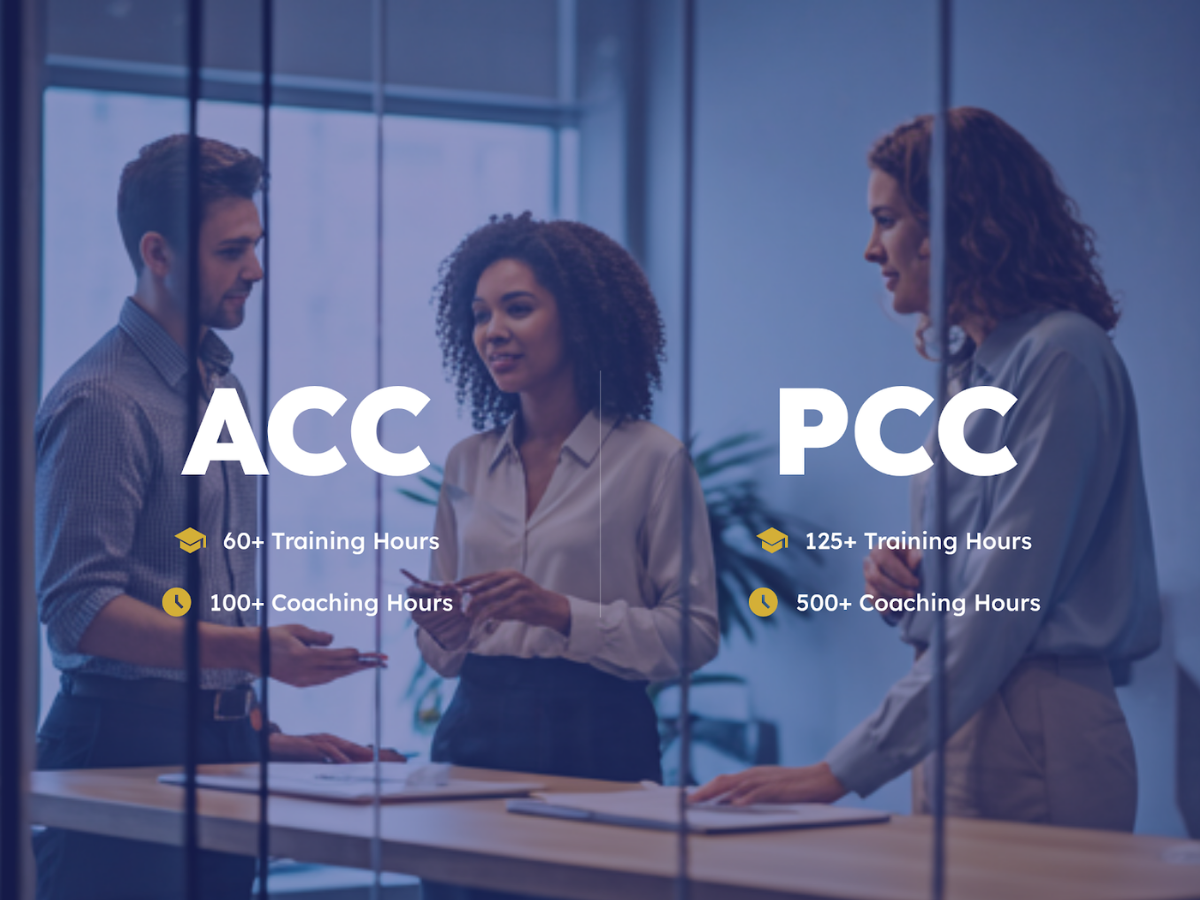
| Coaching Education Hours | 60+ hours of accredited training | 125+ hours of accredited training |
| Coaching Experience | 100+ hours (at least 75 paid) | 500+ hours (at least 450 paid) |
| Minimum Clients | 8 different clients | 25 different clients |
| Recent Coaching Activity | 25 hours within 18 months of applying | 50 hours within 18 months of applying |
| Mentor Coaching | 10 hours over 3+ months | 10 hours over 3+ months |
| Performance Evaluation | A live coaching session assessed against ICF Core Competencies | A live coaching session assessed against ICF Core Competencies |
| Written Exam | 60 knowledge-based questions, 90 minutes | 78 situational judgment items, 180 minutes |
| Passing Score | 460 (on a scale of 200–600) | 460 (on a scale of 200–600) |
ACC Credential Requirements
ACC is designed as the ICF’s entry credential. It recognises coaches who can apply the ICF Core Competencies reliably, with fewer required hours of training and client experience than PCC. In practice, ACC sessions can show a more straightforward session structure – that doesn’t imply that an ACC coach is “lesser”; it reflects how the ICF calibrates an entry credential.
Ideal For:
- New coaches building their first client base
- Career switchers exploring coaching as a profession
- Professionals (managers, consultants, HR specialists) adding coaching skills to their existing roles
- Coaches who want to validate their skills with a globally recognised credential before committing to full-time coaching
What to know beyond the table:
The 100 coaching hours must include at least 75 paid hours – the ICF wants to see that you’re already operating in a professional context, not only coaching friends and family. 25 of those hours must fall within the 18 months before you apply, so you’ll need an active practice when you submit.
Mentor coaching: (10 hours over 3+ months) is often built into an ICF accredited Level 1 program, so check whether your training provider includes it.
Performance evaluation: If your training program is ICF-accredited at Level 1, the performance evaluation is built into your course – no separate submission required.
Pass the ACC Credential Exam: a 60-item multiple-choice exam (90 minutes, scaled passing score of 460).
Pros:
• Faster to earn with a lower barrier to entry
• Provides global recognition and credibility
• Excellent stepping stone toward PCC
Cons:
• Some corporate clients and organisations require PCC as a minimum
• May feel premature for coaches still testing coaching as a career direction
PCC Credential Requirements
PCC is not defined by a different set of competencies – it is the same ICF Core Competencies demonstrated with stronger consistency, range, and depth, supported by significantly higher experience requirements. PCC submissions are expected to show the coach’s ability to work effectively with more complexity, including greater nuance in partnering with the client, evoking awareness, and supporting sustained learning.
Ideal For:
- Full-time professional coaches building a sustainable practice
- Coaches targeting corporate, executive, or organisational clients
- Coaches who want to increase their rates and market positioning
- Experienced professionals (former leaders, consultants, therapists) transitioning into coaching with significant transferable skills
What to know beyond the table:
500 coaching hours (450+ paid, with at least 25 clients) is a substantial body of work — most coaches need 12–24 months of active practice to reach it. 50 of those hours must fall within the 18 months before you apply.
If you already hold ACC, your original 100 hours count toward the 500 total — the counter doesn’t reset.
Performance evaluation: If your training program is ICF-accredited at Level 2, the performance evaluation is completed as part of your course.
Pass the ICF Credentialing Exam – a 78-item situational judgment exam (180 minutes, scaled passing score of 460). This is a different exam to the ACC Credential Exam, and you’ll need to pass it even if you’ve already passed the ACC exam.
Pros:
• Higher credibility and authority in the coaching market
• Stronger earning potential and access to enterprise contracts
• Often the minimum requirement for corporate/executive coaching roles
Cons:
• Requires significant time, financial investment, and client volume
• May feel premature for professionals still exploring whether coaching is the right career direction
The Qualitative Difference Between ACC and PCC
When you are comparing ACC vs PCC it is tempting to focus almost exclusively on the requirements – how many training hours, how many coaching hours, how many mentor sessions. Those details matter. But they don’t tell the whole story.
There is also a distinct (and measurable) qualitative difference between the two credentials – the actual difference in coaching capability that is being taught, developed, and ultimately assessed. The competencies themselves are the same on paper. What changes between ACC and PCC (and therefore Level 1 programs and Level 2 programs) is the depth, consistency, and maturity with which they are demonstrated and taught.
The real question is not just: Can you meet the requirements? It’s: At what level do you want to coach?
A practical way to understand this qualitative distinction between ACC and PCC credentials is to “reverse engineer” them from the point of view that ultimately matters for credentialing: what ICF assessors are listening for in recorded coaching sessions. Here are just a few examples of how coaching might differ from Level 1 (ACC) to Level 2 (PCC).
The Coaching Agreement
This competency refers to the coach’s ability to establish and maintain a clear, shared understanding of what the client wants to achieve – both for the overall engagement and for each individual session. It includes clarifying the topic, defining success, confirming roles and responsibilities, and ensuring the client owns the direction of the work. A strong coaching agreement creates focus without rigidity and allows the session to evolve while staying aligned with the client’s agenda.
At ACC level, the agreement often stays close to the client’s stated topic and immediate aim for the session: what they want to discuss, what outcome they want by the end, and what would make the conversation useful.
At PCC level, assessors are typically listening for a more co-owned contract that clarifies not only the topic, but the measures of success and the shared responsibility for direction. The coach checks what “success” would look like, what the client wants to be different in their thinking or decision making, and how the coach and client will notice progress as the session unfolds, then revisits the agreement when the session naturally shifts.
Presence and Fluidity
Coaching presence refers to the coach’s ability to remain fully conscious, attentive, and flexible in the moment with the client. It involves emotional regulation, comfort with silence, openness to uncertainty, and the ability to respond rather than react. Presence allows the coach to trust the process rather than control it.
ACC recordings can sometimes carry a faint “performance layer”: the coach is working to remember a model, apply a tool cleanly, or demonstrate competency in a way that keeps the session structured. That structure can be appropriate, and it can meet the standard.
PCC sessions, though, tend to sound steadier. The coach is less attached to technique and more responsive to what emerges, allowing the conversation to evolve without losing coherence. Assessors often describe this as fluidity: the coach is anchored, attentive, and able to adapt moment by moment without over steering.
Layered Listening
This competency is about the coach’s ability to listen beyond words — to hear meaning, emotion, assumptions, patterns, and shifts in perspective. It includes attending to tone, pacing, energy, and what may be unsaid, while remaining focused on what matters most to the client. Effective listening informs every intervention the coach makes.
At ACC, listening can be accurate and respectful while still tracking primarily at the surface layer: the facts of the situation, the stated goal, the client’s immediate options.
PCC level listening is more layered. The coach tracks the client’s language, emotions, assumptions, and shifts in energy; notices what’s not being said; and adjusts in real time as the client’s direction changes. It’s not “more questions”, it’s a different sensitivity to meaning, patterns, and what the client is orienting toward as the conversation develops.
Evoking Awareness
Evoking awareness refers to the coach’s capacity to facilitate new insight for the client. It includes asking thought-provoking questions, offering observations, and exploring perspectives that help the client see their situation differently. The aim is not to give advice, but to expand thinking in ways that lead to meaningful choice and forward movement.
ACC inquiry often aims at clarity and immediate resolution: what to do next, what obstacle to remove, what choice to make. That can be entirely appropriate, especially when the client’s goal is concrete.
PCC level inquiry is designed to stretch thinking and widen perspective while still serving the client’s agenda. The coach tests assumptions, invites reframing, and explores the implications of values, identity, and context, so the client’s insight can be more durable than a single action step. In many PCC recordings, the “work” is not only the plan the client leaves with, but the way the client’s understanding of themselves and the situation becomes more nuanced during the session.
Developmental Skill Progression
This progression in coaching maturity is reflected in the way the ICF credentialing pathway is structured. Take Mentor Coaching for example, which is mandatory for both ACC and PCC – it must take place over a minimum of three months. That structure is intentional. It is designed so that a coach can coach, receive feedback, reflect, make adjustments, coach again, and integrate those learnings over time.
This same principle underpins the progression from ACC to PCC. The additional coaching hours are not simply a quantitative hurdle; they create space for depth, pattern recognition, confidence, and refinement. At ICA, our Peer Coaching program is structured to support this developmental arc within the program students choose, allowing coaches to practise consistently while receiving structured feedback. The broader ICF credentialing pathway mirrors this philosophy: credentials are not just milestones, they represent stages of professional capability that unfold through deliberate practice and progressive mastery.
How Long Does It Take to Go from ACC to PCC?
The experience hour gap between ACC (100) and PCC (500) is the most significant difference. This gap reflects not just quantity, but depth of skill development and real-world coaching capability. The timeline depends on how quickly you can accumulate the additional 400 coaching hours and complete any remaining training requirements.
Typical timelines:
- Part-time practice (5–10 hours/week): 18–24 months
- Full-time practice (15–25 hours/week): 9–15 months
- Intensive practice with group coaching: 6–12 months
Strategies to accelerate progression:
- Offer pro bono or reduced-rate coaching to build hours quickly
- Facilitate group coaching sessions (which count toward experience hours)
- Join peer coaching circles to maintain consistent practice
- Set clear weekly coaching goals (e.g., 10 sessions per week)

The Upgrade Path
You can absolutely start with ACC and upgrade to PCC later. Many coaches do exactly this, particularly those who are uncertain about coaching as a long term career or who need to start earning coaching income before investing in additional training.
That said, if you know from the outset that PCC is your goal, pursuing it directly is typically more efficient than climbing the ladder one credential at a time. The upgrade path requires bridging both the training hours (from 60 to 125) and the coaching experience hours (from 100 to 500), which means additional time, cost, and assessments you may have already completed. For coaches with a clear long term vision, starting at PCC level avoids that duplication.
What Upgrading Requires
At International Coach Academy, we’ve designed pathways that support this progression:
- Programs that fulfil the additional training hours requirement, such as our Advanced Professional Program
- Specialty programs for coaches expanding into new areas, such as our Team Coaching Program
- A Bridging Program for coaches who have already completed 60 hours of training elsewhere – including those who already hold an ACC – and want to pathway directly into PCC
Why many coaches choose ACC first (even when they plan to move toward PCC)
Internal coaches, managers, HR professionals, and learning and development practitioners often choose ACC first because they do not need 500 hours of client coaching experience for their current role. Others are constrained by time and budget and need to get credentialed now, with a plan to build hours and apply for PCC later.
In that sense, ACC can function as a credible, professionally useful credential while you build experience at a sustainable pace, especially if your longer term goal is to eventually meet PCC’s higher experience requirements.
How ICA Gets You There
| ICF Requirement | What ICA Provides |
|---|---|
| Coaching Education Hours | We meet all the minimum hours in both our Level 1 (ACC) and Level 2 (PCC) programs. |
| Coaching Experience | The ICF accept “barter coaching” as paid hours so you build coaching experience hours through ICA’s Peer Coaching Program |
| Minimum Clients | Met naturally through Peer Coaching and your own client work. |
| Recent Coaching Activity | Covered as long as you’re actively coaching during the program. |
| Mentor Coaching | Included in the ICA program – delivered by ICF credentialed mentors. |
| Performance Evaluation | You submit an Oral Exam (one session recording) at the end of your program. Your coaching is evaluated by ICA so there’s nothing extra to submit to the ICF. |
| Written Exam | The one thing you do externally – you sit the exam online through Pearson VUE after completing the program. |
* There is also a Portfolio path for coaches who trained outside an ICF accredited program. This requires you to independently prove your training meets ICF competencies and submit recorded coaching sessions for assessment, which is a significantly heavier process. An accredited program handles all of this for you.
The table above shows how ICA maps to each ICF requirement. Here’s how that translates into a training experience designed to take you from enrolment to credentialed coach.
At International Coach Academy (ICA), we actually teach PCC level coaching skills across both our Level 1 and Level 2 programs, which means your skill development and coaching potential can be the same whether you join a Level 1 (ACC) or Level 2 (PCC) program. The practical difference is that when we assess your Oral Exam (a recorded coaching session you submit as part of your training), we assess against your specific program level.
Flexible Pathways Designed for Strategic Choice
ICA’s training model is designed for people who want to make deliberate, career aligned choices about credentialing, without getting boxed into a single “one-way” route. In practical terms, that means:
Start at Level 2 without Level 1: You can start directly in Level 2 (the PCC pathway) without needing to complete Level 1 first.
Upgrade with credited hours: You can start in Level 1 and upgrade later with credited hours, so your learning stays “ahead” of your logbook.
Apply for ACC while building toward PCC: Graduates of ICA’s Level 2 program are eligible for both ACC and PCC credentials, provided they also meet the ICF’s experience/hour requirements. A common strategy is to apply for ACC as soon as you reach 100 coaching hours, so you can demonstrate immediate credibility inside an organisation or in early stage practice building, then apply for PCC once you reach the 500 hour milestone – without needing further training hours in between.
| Feature | What It Means for Your Credential Journey |
|---|---|
| All Inclusive Structure | ICA programs are designed to be all inclusive for the ICF credential process. Required mentor coaching and performance evaluations are built into the program, so you are not left sourcing these components separately after graduation. This reduces administrative delays and makes credentialing a coherent, structured pathway. |
| Building Experience Hours | ICA’s Peer Coaching Program is open and free to all ICA students and graduates. It provides an easy and flexible way to build coaching hours while receiving competency based feedback. It also creates consistency of practice and a reliable rhythm of coaching, often the key difference between feeling “trained” and feeling genuinely ready for assessment. |
| Ongoing Support | ICA Graduates receive lifetime access to the CoachCampus community. This includes continued peer connection, practice opportunities, and professional support beyond formal coursework. Our coaches regularly share information and support around the ICF credentialing process in our online community at ica.coachcampus.com |
| Classroom Flexibility | Our flexible delivery model allows students to choose their pace and participate across time zones. You can fast-track when life allows and steady your pace when work demands increase – while still engaging in a live, international learning environment. For many aspiring coaches, this flexibility is what makes completing the credential both realistic and sustainable. |
Which Credential Is Right for You?
If the detail in this article has been useful but you’re still not sure which credential to aim for, here are some straightforward indicators:
Choose ACC if:
- You are new to coaching and want to validate your skills with a globally recognised credential before committing to full-time practice
- You are integrating coaching into an existing role (manager, HR professional, consultant) and don’t need 500 coaching hours for your current position
- You are constrained by time or budget and need to get credentialed now, with a plan to build toward PCC later
- You are still testing whether coaching is the right long term career direction
Choose PCC if:
- You are building a full time coaching practice and want to position yourself for corporate, executive, or organisational clients from the outset
- You already have significant professional experience – as a leader, consultant, or therapist – and are transitioning into coaching with transferable skills and a clear career vision
- You want to avoid the duplication of completing two separate credentialing processes
- Your target clients or employers require PCC as a minimum standard
Choose With Intention
The wrong choice isn’t ACC or PCC – it’s choosing a credential that doesn’t align with your actual career goals or financial circumstances. Both credentials represent real competence and ICF recognition. The right one depends on where coaching fits in your professional life and where you want to take it over the next five to ten years.
Our Admissions consultants are education experts as well as qualified, experienced coaches. They’ve helped hundreds of coaches work through exactly this decision and can help you find the pathway that fits your goals, timeline, and circumstances.
Book a consultation to discuss your coaching goals and find the program that’s right for you. The credential you choose today shapes the coach you become tomorrow, so choose with intention.